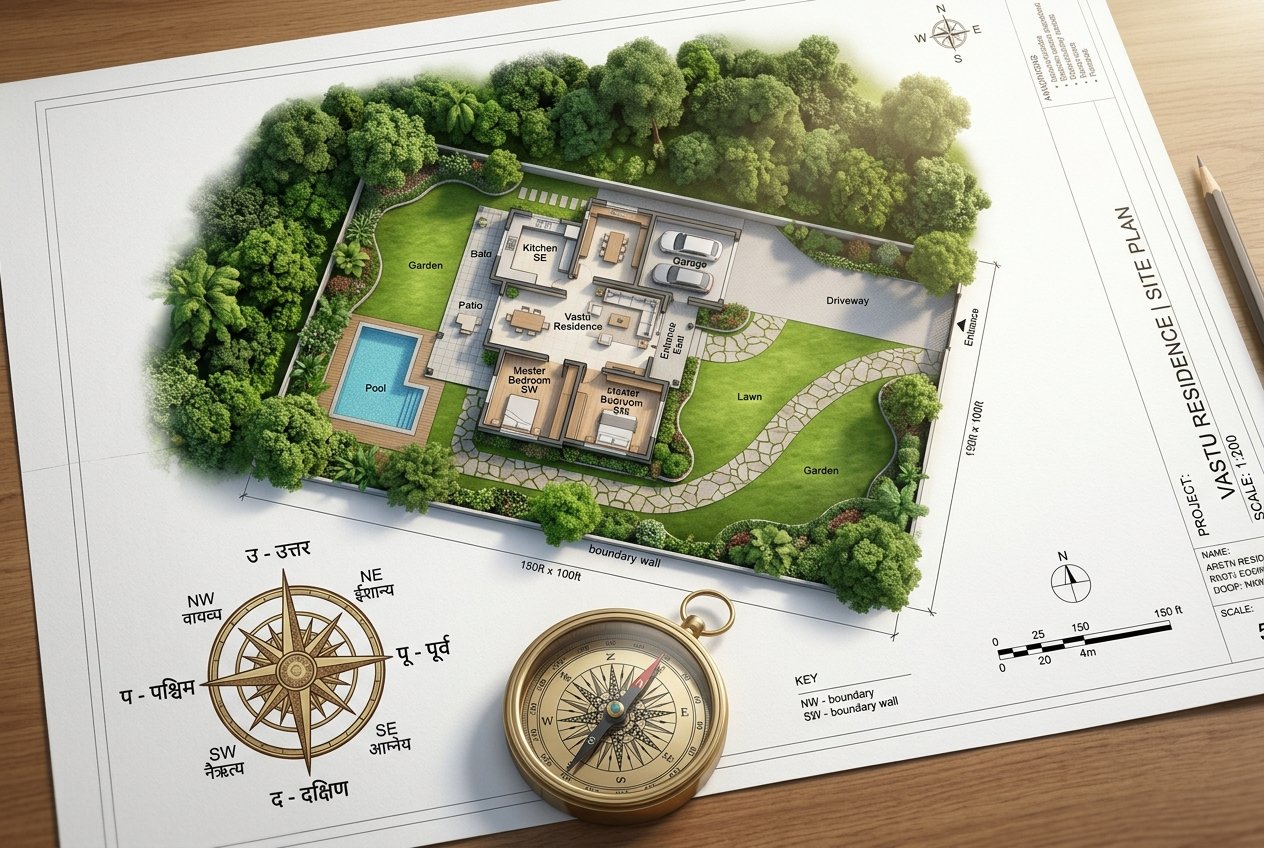
Across Indian real estate—whether you are looking at plotted sectors along the Yamuna Expressway, independent kothis in Noida, or scenic estate parcels in Herbertpur, Dehradun—corner plots invariably carry a higher price tag. In developer terminology, this is billed as a Preferential Location Charge (PLC), often adding 10% to 15% to the base land price.
Buyers often ask: Is this premium purely driven by traditional Vastu Shastra belief, or are there quantifiable architectural and lifestyle advantages to owning a corner plot?
Vastu Directional Matrix: Plot Orientations & Recommended Planning
| Orientation | Road Frontage | Vastu Classification | Recommended Space Allocation |
|---|---|---|---|
| North-East (Ishanya) | North & East Roads | Highest Auspicious (Param Shubh) | Open lawn, water body, puja room, lower ground level |
| North-West (Vayavya) | North & West Roads | Favorable (Shubh) | Guest bedroom, secondary garage, study room |
| South-East (Agneya) | South & East Roads | Moderate (Requires fire balancing) | Kitchen, electrical panel room, generator installation |
| South-West (Nairutya) | South & West Roads | Requires Structural Mass Balancing | Master bedroom suite, overhead water tank, highest wall |
1. The Architectural Realities: Why Corner Plots Live Better
Leaving aside traditional philosophy, a corner parcel delivers distinct structural advantages that standard intermediate plots (sandwiched between two neighbors) cannot match:
- Dual-Side Natural Illumination: Intermediate plots can only place windows on the front and rear facades. Corner plots enjoy 270 degrees of natural light, allowing cross-ventilation in all living spaces.
- Independent Dual Access: Architects can configure two separate gates—for example, a formal guest entry on the primary avenue and a private driveway/carport on the side road.
- Greater Setback Flexibility: Side road frontages allow wider wrap-around garden envelopes, verandahs, and elevated balcony views without looking directly into a neighbor's wall.
2. What Vastu Actually Prescribes: Fact vs Misconceptions
In traditional Vastu Shastra, not all corner plots are treated equally. Directional alignment dictates their auspicious classification:
- North-East Corner (Ishanya): The most revered orientation. Road frontage on the North and East allows morning solar radiation (prana energy) and positive airflow. It is considered ideal for peaceful family residence and spiritual harmony.
- North-West Corner (Vayavya): Roads on North and West bring dynamic movement. Excellent for active professionals and entrepreneurs.
- South-East (Agneya) and South-West (Nairutya): South-West corners are traditionally considered heavy and require specific architectural balancing, such as positioning heavier master bedrooms and higher boundary walls on the South-West perimeter.
3. The Significance of Plot Geometry: Gaumukhi vs Shermukhi
Beyond corner status, plot geometry significantly impacts usability and Vastu rating:
- Gaumukhi (Cow-faced): Narrow at the road entrance and wider at the rear. In Vastu, this shape symbolizes retention of wealth and peace, making it the gold standard for residential plots.
- Shermukhi (Lion-faced): Broad at the entrance and tapering toward the rear. While discouraged for purely quiet residential homes, it is considered highly powerful and lucrative for commercial showrooms and corporate headquarters.
4. Does the Corner Premium Pay Off at Resale?
Empirical registry data across Noida and Dehradun indicates that well-proportioned North-East and North-West corner plots retain liquidity far better during slow market cycles. When buyers look at resale inventory, corner units are typically the first to receive competitive bids.
Looking for verified corner plots?
Explore boundary-surveyed corner and dual-frontage plots in our Herbertpur and Noida inventory.
Frequently Asked Questions
What is a road-hit (Vithi Shoola) and is it dangerous?
A road-hit occurs when an incoming T-junction road points directly at the plot boundary. While South and South-West road hits are traditionally avoided, North and North-East road hits are considered highly auspicious and can be further balanced with landscape buffers.
Do corner plots require higher municipal setback margins?
Yes. In authorized layouts, building bye-laws often mandate setbacks from both road frontages to preserve vehicular visibility around corners, which architects incorporate into perimeter landscaping.
Can irregular corner plots be corrected during construction?
Yes. Structural boundaries can be squared off internally with perimeter gardens, compound wall offsets, and green hedging to create a perfect 90-degree internal living rectangle.